

I’ve spent years curating stories, but my greatest adventure began when I reimagined how to store and celebrate books. A turning point? Seeing designer Nate Berkus’s iconic double-height bookcase. Its symmetrical alcoves and rainbow-colored spines taught me shelves aren’t just functional—they’re art.
Stephanie Sabbe’s work shifted my perspective further. Her built-in window seat libraries, like the blush-toned nook designed for monthly book clubs, showed how spaces could invite connection. These influences helped me realize: a true reading sanctuary balances beauty with comfort.
Through trial and error, I discovered even cramped corners can become literary escapes. The secret lies in intentional layouts and multi-functional solutions. Floor-to-ceiling storage maximizes vertical space, while plush seating transforms unused areas into reading zones.
This journey taught me that personal libraries aren’t about square footage. They’re about creating environments where stories feel alive—whether through bold color schemes, clever lighting, or textures that make you want to linger.
Key Takeaways
- Vertical shelving doubles storage while adding dramatic visual impact
- Built-in seating around windows creates ideal natural reading light
- Color-coordinated bookshelves turn collections into decorative statements
- Multi-level lighting (ambient + task) enhances functionality and mood
- Textured throws and cushions boost comfort without sacrificing style
Welcome to My Cozy Home Library Journey
Books have always been my escape, but transforming that passion into a physical space took unexpected inspiration. What began as a childhood habit of stacking paperbacks under my bed evolved into a deliberate quest to blend literature with interior design. The real shift happened when I discovered how professionals reimagine ordinary rooms into immersive story havens.
How My Love for Books Shaped This Space
Growing up, I measured rooms by their reading potential—window ledges became chapter perches, closets turned into secret book forts. When I moved into my first apartment, I finally had walls to call my own. That’s when I realized: a dedicated library isn’t a luxury—it’s a lifestyle upgrade. I started studying designers who specialize in literary spaces, craving their expertise.
The Influence of Expert Designers
Anne McDonald’s “English snug” concept changed everything. She pairs burgundy walls with whiskey-toned leather chairs, proving dark hues can feel inviting. Then there’s CeCe Barfield Thompson, who taught me to see double-duty spaces. Her Manhattan apartment designs merge dining tables with built-in shelves—perfect for book clubs with wine pairings.
| Designer | Signature Technique | Space Impact |
|---|---|---|
| Anne McDonald | Moody color palettes + dry bars | Creates intimate retreats |
| CeCe Barfield Thompson | Multi-functional furniture layouts | Maximizes small square footage |
| My Key Lesson | Balance aesthetics with emotional resonance | Transforms rooms into sanctuaries |
These visionaries showed me that lighting placement matters as much as shelf styling. A reading lamp’s glow or a sconce’s warm beam doesn’t just illuminate pages—it sculpts mood. Now, every design choice in my home library serves both function and feeling.
25 Cozy Home Library Ideas for Every Space
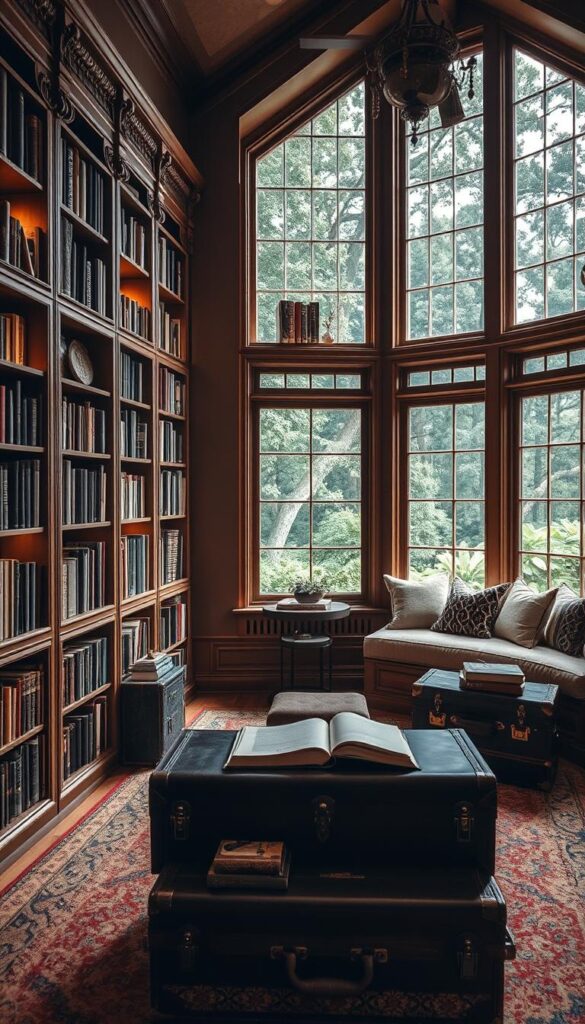
Curating literary spaces taught me one truth: great design thrives within limitations. Whether transforming stairwell nooks or reimagining dining areas, these solutions blend practicality with personality. Let me share strategies that work in Texas ranch houses and Brooklyn studios alike.
Manhattan designer Jessica Lagrange once told me, “Bookshelves should frame life, not interrupt it.” This philosophy shaped my approach. Built-in benches beneath bay windows create reading spots that double as guest seating. Floating shelves around doorways turn unused wall space into display galleries.
| Space Type | Design Solution | Influencer Inspiration |
|---|---|---|
| Small Nooks | Angled shelves + fold-down desk | Leanne Ford's Pittsburgh project |
| Window Areas | Cushioned bench + adjustable sconces | Studio McGee's Utah cabin |
| Dining Rooms | Ceiling-height cabinets + hidden ladders | Amber Lewis' California remodel |
Color-blocking paperbacks creates visual rhythm without expensive renovations. Grouping books by spine hue transforms cluttered shelves into art installations. For tighter budgets, painting existing bookcase backs in matte black adds instant depth.
Lighting makes or breaks a reading zone. Layering puck lights under shelves with dimmable overhead fixtures allows mood adjustments. In my West Village friend's apartment, we installed LED strips along crown molding – invisible by day, magical at night.
These concepts prove literary havens adapt to any architecture. The secret? Treating storage as storytelling. Every shelf becomes a chapter in your home's narrative.
Setting the Mood: Calming Palettes and Soothing Lighting
The magic of a great reading space lies in its ability to wrap you in comfort before you even open a book. Designer Gina Sims taught me how color shapes emotion. “Cooler tones like muted greens act as visual deep breaths,” she explains. Taking her advice, I transformed my room with sage walls and a powder-blue armchair – a combo that instantly softened the atmosphere.
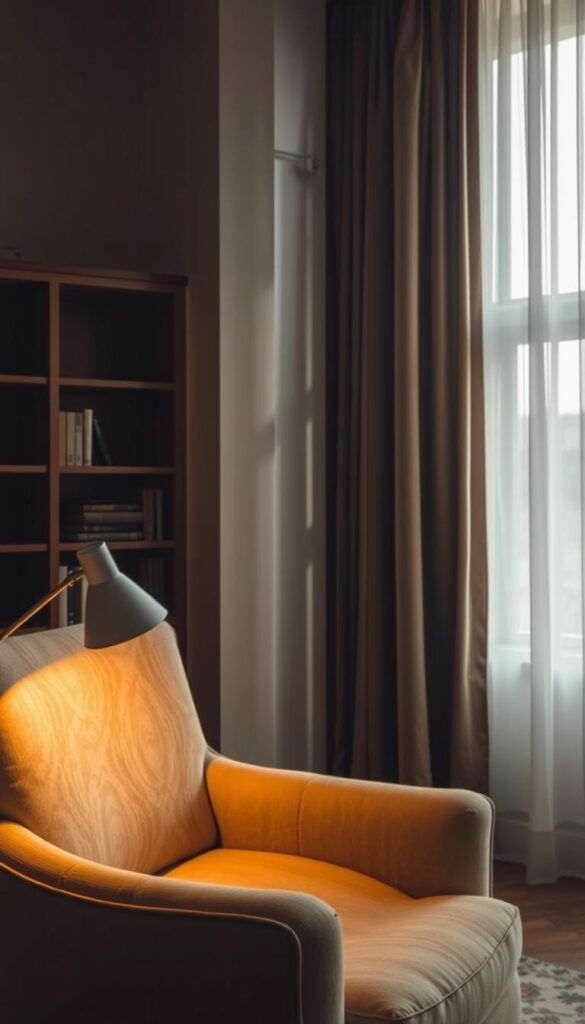
Selecting the Perfect Wall Colors
Marie Flanigan’s work showed me how metallic accents elevate muted schemes. In my space, brass sconces and framed poetry pages add warmth against the cool backdrop. This balance creates depth without overwhelming – crucial for maintaining focus during long reading sessions.
Lighting Techniques for a Relaxing Ambiance
Layered illumination changed everything. Here’s what works best:
- Ambient: Recessed ceiling lights set to 40% brightness
- Task: Adjustable desk lamp with 2700K bulbs
- Accent: LED strips under floating shelves
I learned through trial that dimmer switches are non-negotiable. They let me shift from morning study mode to evening unwind time seamlessly. As Flanigan once told me: “Light should hug your books, not interrogate them.”
Maximizing Space with Clever Shelving Solutions
My shelves became my greatest teachers in spatial alchemy. Drew McGuckin’s genius nook design—blending a workspace with hidden storage—proved even awkward corners hold potential. “Built-ins should work harder than you do,” he told me during a design conference. That philosophy changed how I approach vertical surfaces.
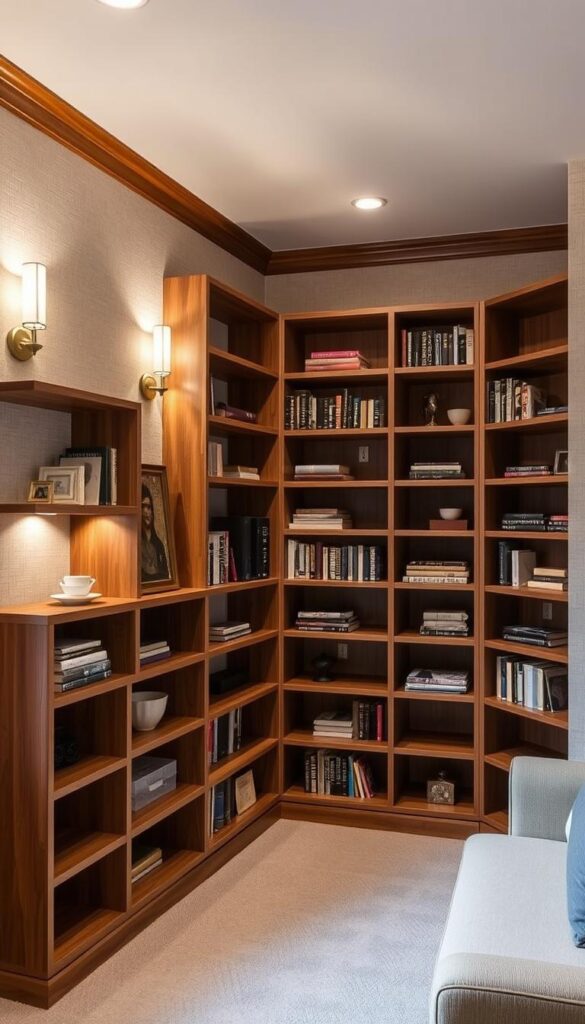
Custom Built-Ins and Floating Shelves
Jeffrey Sherman’s heart-pine masterpieces showed me height equals opportunity. His rolling ladder system makes top shelves accessible while adding industrial flair. I replicated this in my studio using reclaimed wood and antique brass hardware. The result? A bookcase that stores 300+ titles without overwhelming the room.
Floating shelves solved my rental apartment dilemma. Unlike permanent structures, they let me reshape my space quarterly. I stagger them around windows now, creating sunlit displays for favorite novels. Pro tip: leave 30% empty for future finds and decorative accents.
Here’s what I’ve learned from top designers:
- Depth matters – 12-inch shelves accommodate art books
- Mix open and closed storage to reduce visual clutter
- Extend built-ins around door frames for seamless integration
While custom solutions cost more upfront, their impact justifies the investment. My McGuckin-inspired nook increased usable storage by 40% – proof that smart design pays dividends.
Designing a Charming Reading Nook
Transforming overlooked spaces into literary retreats became my latest obsession. Designers like Stephanie Sabbe and Kim Kneipp taught me that even modest areas can become immersive escapes. Their work proves intentional design turns forgotten corners into story-fueled sanctuaries.
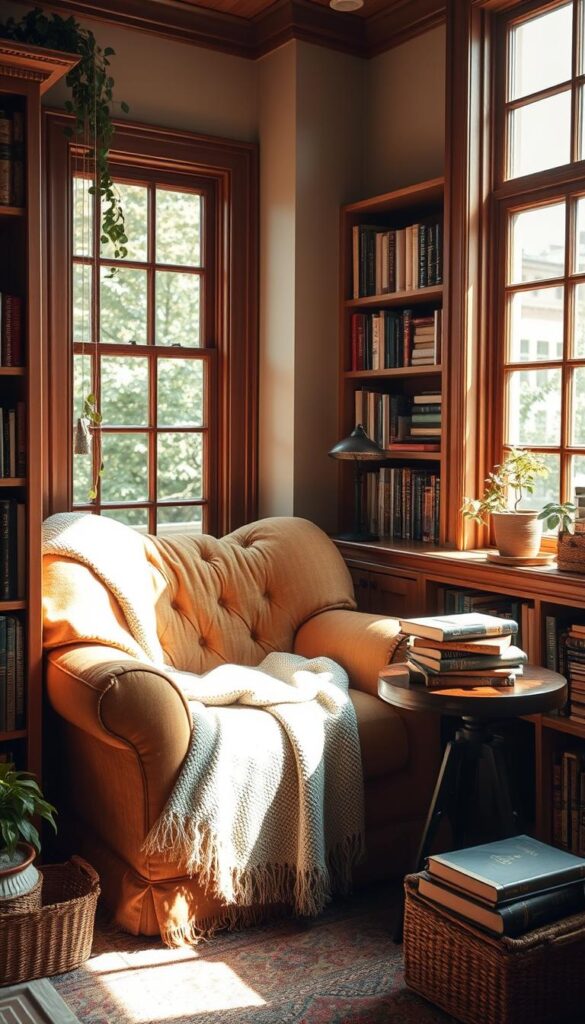
Window Nook Inspirations
Stephanie Sabbe’s blush-toned window seat changed how I view natural light. Her built-in shelves frame views while housing book club selections. I replicated this by adding a cushioned bench beneath my bay window—now my favorite spot for morning reads.
Cozy Corners Under the Stairs
Kim Kneipp’s moody alcoves inspired my under-stair transformation. Dark emerald paint and layered textures create intimacy. I installed adjustable sconces and hidden drawers for practicality. As Kneipp says: “A great nook feels like a whispered secret.”
Three essentials elevate any reading corner:
- Light layering: Combine daylight with dimmable lamps
- Textural contrast: Mix plush fabrics with structured shelving
- Personal touches: Display favorite novels or travel mementos
These spaces prove you don’t need grandeur to craft meaningful escapes. Sometimes, the best stories unfold in quiet corners.
Infusing Personal Style Through Bold and Unique Decor
Designer Katie Ridder’s lime-green libraries first showed me color could rewrite design rules. Her spaces reject predictable mahogany tones, using saturated hues as personality markers. “Bookshelves shouldn’t whisper—they should sing your song,” she told me during a studio visit. That philosophy reshaped how I view decorative risks.
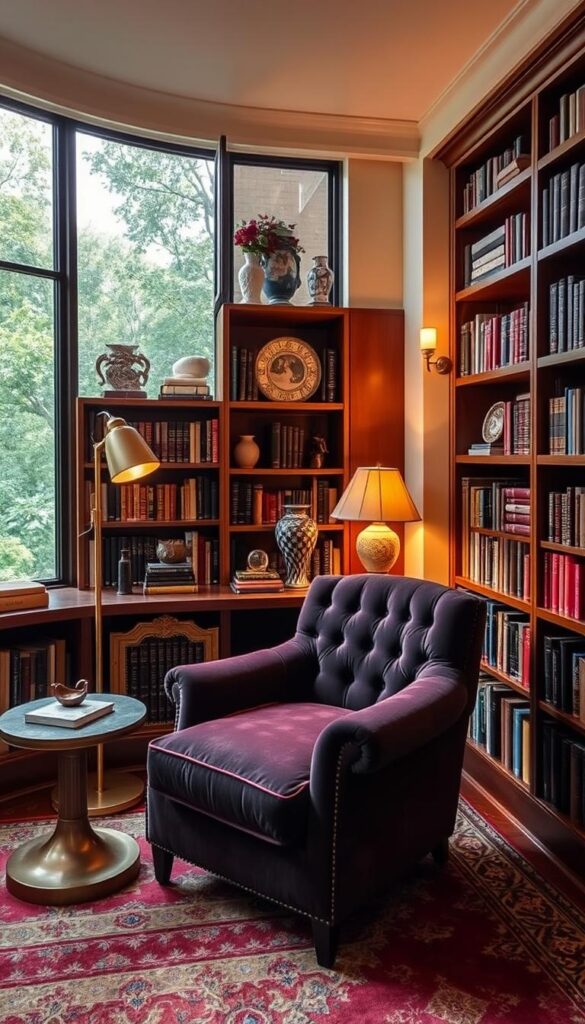
Sherrell Neal’s work proves even unexpected items belong in literary design. He seamlessly integrates football helmets and vintage maps into shelving displays. My own space now features my grandfather’s typewriter beside modern art books—a juxtaposition that sparks conversations.
Three principles guide successful personalization:
- Anchor bold choices: Neon shelves? Balance them with neutral seating
- Curate meaningfully: Display items with emotional resonance
- Edit ruthlessly: Leave breathing room between statement pieces
I learned through trial that the best rooms feel layered over time. My client’s aviation-themed nook grew organically—model planes joined navigation charts, then a propeller coffee table emerged. Now it’s a library that truly soars.
Double-Height and Floor-to-Ceiling Bookcase Inspirations
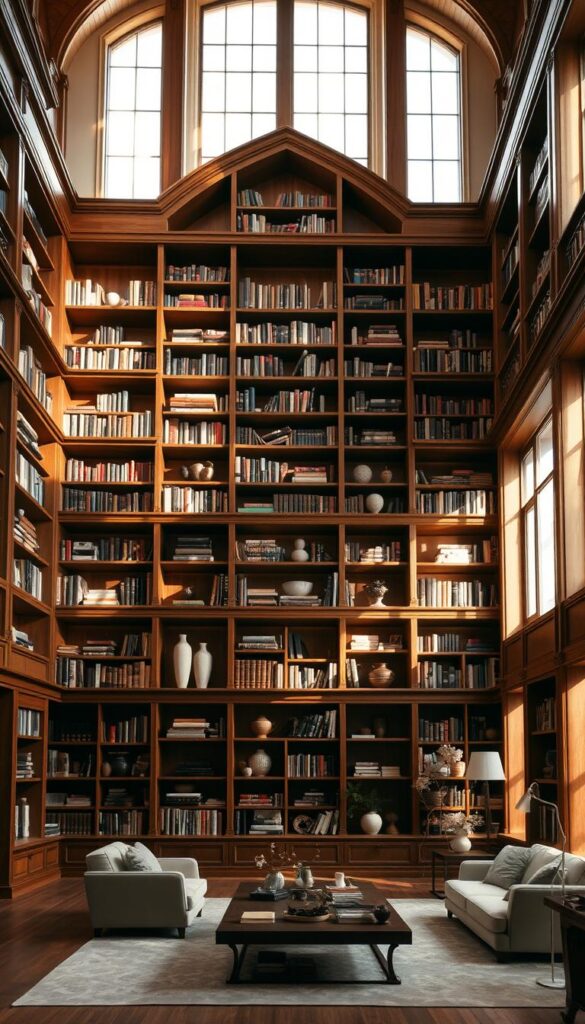
Architectural possibilities unfold when shelves stretch skyward. Nate Berkus once told me, “A well-designed bookcase should command attention like a fireplace.” His iconic double-height installation proves this—symmetrical square alcoves house rainbow-sorted titles that transform storage into kinetic art. The effect? A living wall where literature becomes decor.
Designer Spotlights and Influencer Narratives
Jeffrey Sherman’s heart-pine masterpieces reshaped my understanding of vertical space. His floor-to-ceiling designs in airy rooms feature industrial ladders that glide effortlessly. “Accessibility meets drama,” he explained during a studio tour. I replicated this by adding brass hardware to my own shelves—now even top-tier art books feel within reach.
Three lessons from these installations changed my approach:
- Scale proportionally: Match shelf height to room dimensions
- Light strategically: Uplighting emphasizes verticality
- Curate intentionally: Reserve upper tiers for visual statements
Berkus’s color-blocked arrangements taught me coordination beats quantity. Grouping novels by spine hue creates rhythm without renovation costs. In my Brooklyn rental, I used removable vinyl to achieve similar cohesion—a renter-friendly trick that packs designer punch.
These concepts prove that bold shelving transforms rooms into layered experiences. When executed thoughtfully, floor-to-ceiling designs don’t just store stories—they become them.
Innovative Book Storage and Hidden Features
I never realized how much magic could be hidden within a bookshelf until I encountered transformative designs. Garrow Kedigian’s Parisian-inspired glass cases rewrote my understanding of functional elegance. Using vintage flea market hardware, he crafts displays that store books like museum artifacts while radiating old-world charm.

Secret Compartments and Convertible Furniture
Christina Seilern’s work took concealment to new heights. Her full-height shelves hide four seamless doors in a London townhouse—guests literally can’t find the exits. This clever use of space taught me that walls can multitask as secret passageways and storage heroes.
| Designer | Innovation | Functional Benefit |
|---|---|---|
| Garrow Kedigian | Antique glass book cases | Dust-free display + vintage aesthetic |
| Christina Seilern | Hidden door systems | Space optimization + architectural intrigue |
| Modern Solution | Convertible shelf dividers | Room separation + concealed compartments |
Convertible furniture became my go-to for tight spaces. A client’s library now features shelves that pivot to reveal a media console. Another project uses hollowed “book spines” to hide charging stations. These solutions prove that every inch can serve multiple purposes when creativity leads.
The best hidden features balance surprise with practicality. Kedigian’s protected displays guard rare editions, while Seilern’s doors maintain clean sightlines. As I’ve learned: clever storage isn’t just about hiding things—it’s about revealing possibilities.
Transforming Odd Spaces into Inviting Libraries
Some of the most captivating literary escapes hide where you least expect them. Eric J. Smith’s climate-controlled passageway library reshaped my understanding of spatial potential. His design preserves 1,700 poetry volumes while creating an artistic pathway to a writer’s studio—proof that narrow corridors can become intellectual highways.
I’ve since discovered designers reimagining barn lofts and attic eaves as reading sanctuaries. Even bathroom nooks gain new purpose with waterproof shelving and humidity controls. The key lies in viewing every inch as an opportunity to make space for stories.
My own experiments taught me that depth matters more than square footage. Floating shelves along stairwells turn ascents into literary journeys. Slim ledges above door frames display favorite paperbacks without crowding the room. It’s about working with what you have, not waiting for perfect conditions.
These unconventional solutions prove one truth: there’s always a way to weave literature into your home. Whether converting closet corners or hollowing out fireplace surrounds, creativity transforms limitations into invitations. After all, the best stories often begin in unexpected places.